
Our
impact in
CHPI's work in 2025 took place against a backdrop of continued financial pressure on local NHS bodies and a rapid increase in private equity ownership of companies delivering NHS funded services.
Our research focused on a single underlying issue. Very large amounts of taxpayer money are flowing out of the NHS to private companies, in the form of profits and interest payments on high cost loans, with serious consequences for the financial sustainability of the NHS.
Across the year we published the third and final report in our series on the outsourcing of NHS cataract care, a briefing note and an online postcode tool, a blog by two specialists in financial crime, and Market Failure, a report on the under regulated market in NHS funded ADHD services. The work was covered by The Sunday Times, The Guardian, Pulse, the Evening Standard and the Independent, cited in briefings to ministers, and taken up by MPs, peers and professional bodies. By the end of the year, profit leakage from the NHS had become a recognised part of the national policy debate.
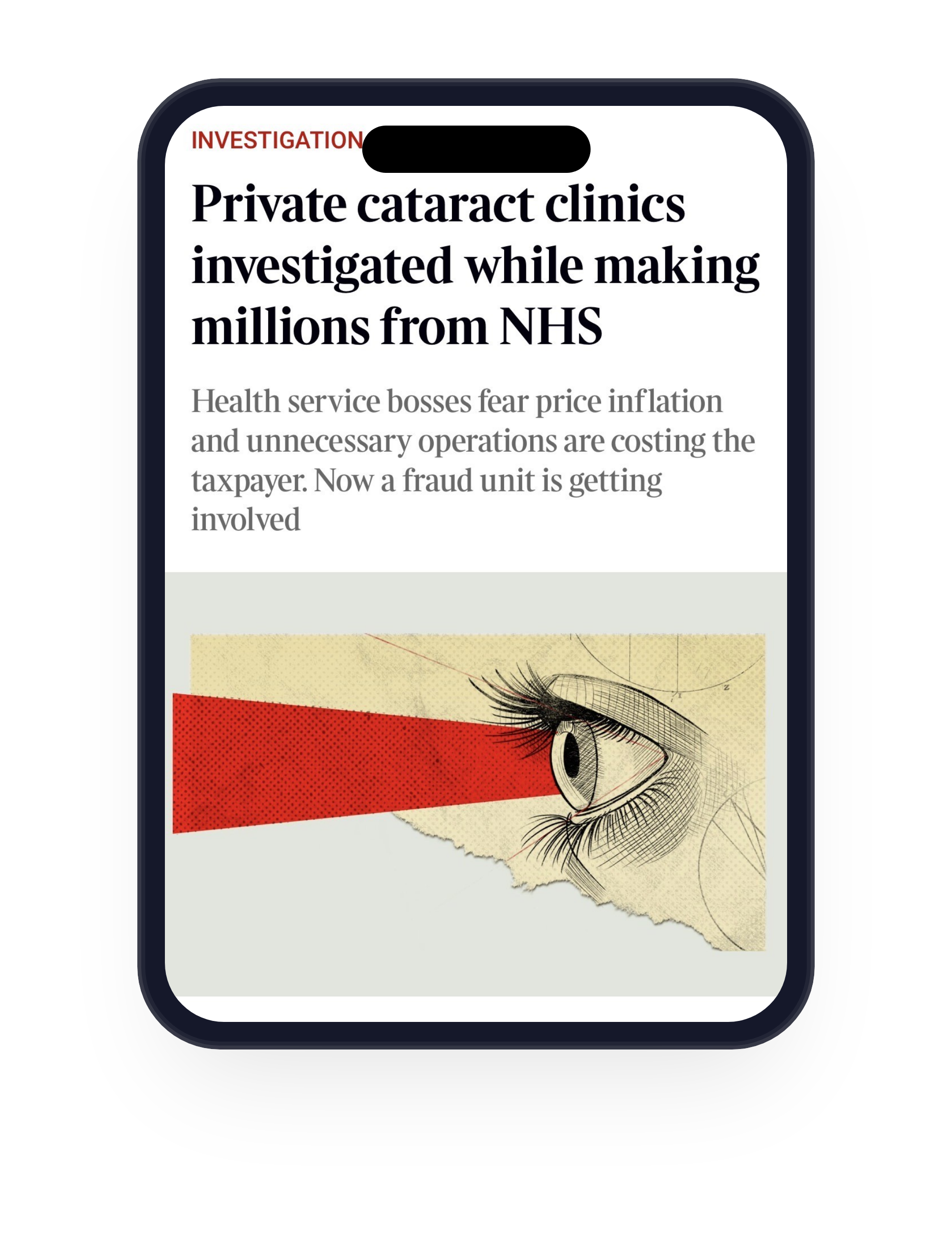
In April 2025 CHPI published Out of Sight, the third and final report in our series on the outsourcing of NHS cataract care to the private sector. The Sunday Times covered the report exclusively on the day of publication.
The research was based on NHS expenditure data, Freedom of Information requests, Companies House accounts and interviews with staff at NHS England. It focused on five private companies set up to deliver cataract care to NHS patients, which generate the majority of their income from the NHS. Of all the public interest investigations CHPI has carried out into the growth of the private sector in England, the findings of this work were the most striking.
The headline finding was simple and stark. Of the £536 million the NHS spent on these five companies in a single year, £169 million went straight to profit. That is around one pound in every three, and it did not go towards patient care. Behind that figure sits a business model built on debt: the five companies carry £620 million of borrowing, much of it taken on by private equity investors at high interest rates, and in some cases they spent more on servicing that debt than on the staff delivering the care.
Out of Sight, the third report on the outsourcing of NHS cataract care
£169m
of the £536m the NHS spent on five private cataract providers in a single year became company profit.
Around £1 in every £3 — and it did not go to patient care.
The five companies carry £620m of debt, and spent £68m on interest on high cost loans in one year, in some cases more than they spent on staff.
The local and national impact of profit leakage in NHS eye care
In May 2025 CHPI published a briefing note on the local and national impact of profit leakage in NHS eye care, together with an online postcode tool. The Guardian covered the launch on the day of publication, under the headline that profits from NHS eye care outsourcing matched all 100 PFI contracts.
The postcode tool let members of the public enter their postcode and see how much their local Integrated Care Board had spent on the five private eye care companies named in Out of Sight, how much of that money had leaked out as profit, and how much had gone on interest on the high cost loans taken out by private equity investors. For the first time, the public, local journalists, councillors and MPs could question their own ICB about its spending on the private sector.
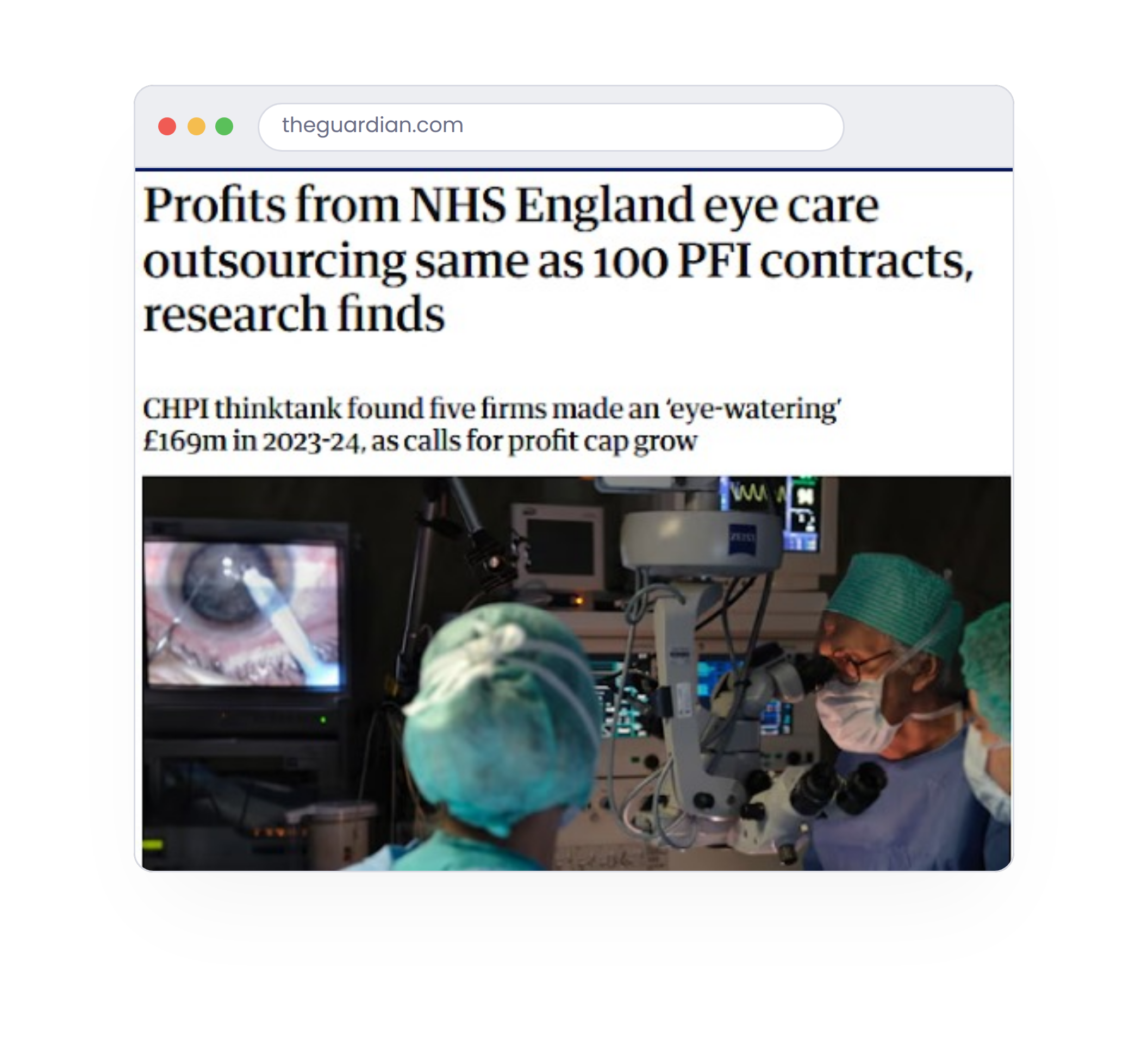
The briefing added two further pieces of analysis. The first was the comparison with the Private Finance Initiative shown above. The second was a modelling exercise on the effect of a cap on profits. In 2024 the Education Secretary suggested capping profits in children's social care at 8.8%. If a similar cap had applied to the five private eye care companies in 2023/24, the NHS would have saved £122 million on outsourced eye care alone, and the aggregate finances of all Integrated Care Boards would have moved from an overall deficit into a surplus of £12.5 million.
Five companies made more profit in one year than all 100 NHS PFI schemes combined, on average.
100 PFI schemes 5 cataract companies
Cap their profit at 8.8%
+£12.5mevery ICB could move into surplus
£122m saved for the NHS in a single year.
Corporate Fraud and the NHS
In September 2025 CHPI published a blog by Dr Diana Johnson of the University of the West of England and Professor Nic Ryder of Cardiff University, two academic specialists in financial crime. It followed reporting in The Sunday Times in April 2025 that the NHS Counter Fraud Authority was investigating billing irregularities at some private cataract clinics.
At the centre of the concern is how operations are coded. The NHS pays around £400 more for a cataract recorded as complex than for a simple one. Since private clinics became the main provider of NHS cataract surgery, the number of operations billed as complex has risen by 144% over five years, a rise that no change in the complexity of the patient population can explain. The Royal College of Ophthalmologists has raised the concern that this may amount to upcoding, the practice of recording procedures as more complex than they are for financial gain.
The blog set out that where concerns of this kind arise, a non-binding agreement between government and the private sector is not a sufficient response, and that the issues should be properly investigated by the relevant authorities. Both CHPI and the authors were clear that there is no evidence of wrongdoing by any company or individual.
+£400
more, each time an NHS cataract operation is coded “complex” rather than “simple”.
144% rise in “complex” cases
Since private clinics became the main provider of NHS cataract surgery, the number of operations billed as complex has surged — with no change in the patient population to explain it.
Market Failure and the under regulated market in NHS funded ADHD services
In January 2026 CHPI published Market Failure, a report researched in 2025 on the outsourcing of NHS funded ADHD diagnosis and treatment to private companies. The Guardian covered it on the day of publication.
The report was based on a Freedom of Information survey of England's 42 Integrated Care Boards, a review of provider websites and accounts, and a review of ICB board papers. It took no view on whether the current system leads to under or over diagnosis of ADHD. It looked instead at how the market based arrangements for assessment and treatment are working for patients and for the wider NHS.
Provision is poorly regulated. Providers of ADHD assessments are not required to register with the Care Quality Commission, and there is no agreed national qualification to certify an assessor's competence. The research found that 19 companies provided £1.9 million of ADHD services to NHS patients with no evidence of any contract, and a further 14 companies providing £3.5 million of services were not registered with the CQC.
Against that weak oversight, spending has risen sharply. Money paid to private ADHD providers increased by 252% over three years, from £16.3 million in 2022/23 to £58 million in 2024/25, and one provider generated a 33% profit margin. Because the market based rules prevent Integrated Care Boards from capping what they spend, their budgets in this area were overspent, on course to run well beyond the amounts originally planned.
The report concluded that the government faces a choice. It can allow the current market based system to continue, and risk private companies making significant returns at the expense of the financial sustainability of the NHS. Or it can reverse the commitment to expanding the private sector, and give local NHS bodies the full power to plan services according to the needs of their population.
2022/23£16.3m
2024/25£58m
Spending on private ADHD providers more than tripled in three years.
One provider makes a 33% margin. This market has grown with no requirement to register with the Care Quality Commission, and no national standard for who can carry out an assessment.
In brief: our impact in 2025
Our work in 2025 focused on a single issue: the very large amounts of taxpayer money flowing out of the NHS to private companies as profit and as interest on high cost loans, and what this means for the financial sustainability of the NHS. Across the areas of care we examined, we estimate that around £1.6 billion has leaked out of the NHS in profit over a two year period.
Out of Sight
£169m in profit taken from NHS cataract care in a single year. Covered exclusively by The Sunday Times.
Profit leakage mapped
A public postcode tool, and profits greater than all 100 NHS PFI schemes. Covered exclusively by The Guardian.
Corporate Fraud and the NHS
Two specialists in financial crime examined the concerns raised by our cataract research.
Market Failure
NHS spending on private ADHD providers up 252% in three years. Covered by The Guardian.
Privatising ADHD diagnosis
A blog by CHPI Director David Rowland making the case for a cap on private profits. Featured by the LSE.
Policymakers, regulators and media
Cited in ministerial briefings, by professional bodies, and by campaigning organisations.